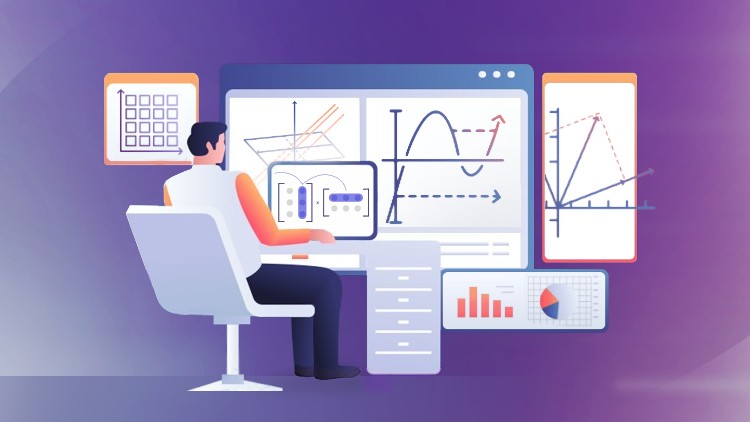
Linear Algebra is one of the essential foundations for anyone who wants to work in Data Science and Artificial Intelligence. Whether manipulating large datasets, building predictive models, or implementing Machine Learning algorithms, a solid understanding of this mathematical field is indispensable. This course is designed to provide an intuitive and practical approach to the most important concepts, combining theory and Python implementations to ensure you learn by applying.
The course is divided into six sections, each covering a fundamental aspect of Linear Algebra. We begin with an introduction to core concepts, explaining the importance of this discipline and how it connects to Data Science and Machine Learning. Here, we cover elements like scalars, vectors, matrices, and tensors, along with setting up the necessary Python libraries. We also explore data representation and how linear systems are used to solve mathematical problems.
In the second section, we dive deeper into vectors—their properties and applications. Vectors are fundamental components in data manipulation, feature scaling, and even defining the multidimensional spaces used in predictive models. You’ll learn about norms, unit vectors, orthogonal and orthonormal vectors, and visualize these structures intuitively through graphs.
Next, we explore matrices, which are widely used to represent data and process large volumes of information. We’ll cover key matrix properties, norms, transposition, inversion, and essential decompositions for diverse applications. These concepts are critical for neural networks, linear regressions, and dimensionality reduction techniques.
The fourth section focuses on operations involving vectors and matrices. We’ll study matrix multiplication, dot and cross products, reduction operations, and the cosine rule—essential tools for calculating data similarity and efficiently manipulating mathematical structures.
Then, we tackle linear transformations, a key concept for many advanced Machine Learning applications. We’ll examine how matrices enable operations like reflection, scaling, rotation, and shearing, while introducing eigenvectors, eigenvalues, and matrix decompositions. Techniques like Eigendecomposition, Singular Value Decomposition (SVD), and Principal Component Analysis (PCA) are explored here—indispensable tools for data compression and redundancy removal in learning models.
Finally, the sixth section is entirely dedicated to practical applications of Linear Algebra in Data Science and AI. We’ll implement linear systems, explore how neural networks leverage these mathematical concepts, dive deeper into Eigendecomposition and SVD, and apply PCA for analysis and dimensionality reduction. We’ll also work with techniques to measure similarity in structured data, ensuring you can use this knowledge to solve real-world problems. The section concludes with exercises to reinforce your learning.
By the end of this course, you’ll have a strong command of Linear Algebra applied to Data Science and Machine Learning—mastering not just the theory but also its implementation in Python. If you aim to build a rigorous mathematical foundation for professional work in AI and data, this course is an essential step in your journey.