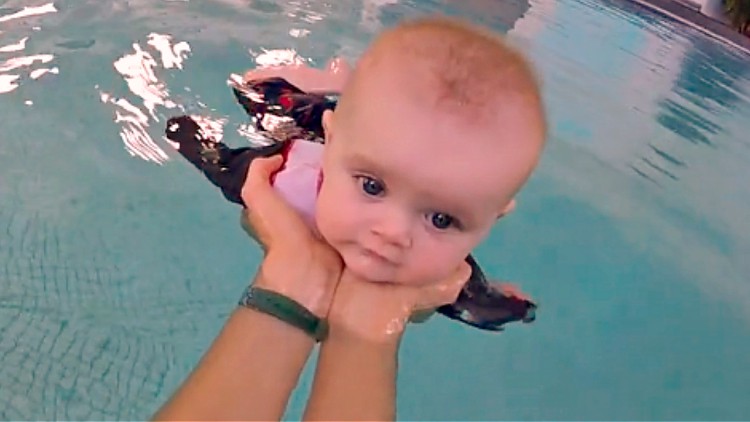
I'm going to show you how to introduce your baby to the water with my gentle teaching approach. This proven method is the best way to develop a love of the water in your baby. With early exposure to water, your baby will never develop a fear; instead, they will learn to love and respect it.
A child who respects the water understands the dangers that lie within. With this knowledge, they're less likely to put themselves in danger. Instill this crucial message in your child today.
I understand, however, if you feel a little nervous. Not to worry, your confidence will grow as you see how easy it is to learn this gentle teaching method.
Several years before I became a swim instructor, and I was a new mother, I felt a little nervous being around water with my baby. But then my husband, Ross, quickly turned that around for me when we gave our son one of his first baths. At one point, Ross poured the water over our son's head, and I was taken aback by the dumping of the water over his head and down his face, covering his eyes, nose, and mouth for what seemed like an eternity, but probably lasted two seconds, to be honest.
Ross said, "don't worry, it doesn't hurt him."
He seemed very confident in his statement, and I trusted him. I was right to trust him. Our son never developed a fear of water on the face. So, learning how to swim was second nature to him.
This course is broken down into easily digestible bite-sized chunks. The structure follows a natural order and provides you with everything you need to teach your baby to swim, including but not limited to...
Prepared lesson plans. You will also have access to a lesson plan template if you want to create your own.
Skills at a glance PDF for easy lesson planning.
Clearly written instructions. Each skill is broken down into an easy to follow step by step guide.
Video tutorials with demonstrations of each skill captured from actual classes.
A video library of songs. Each video tutorial shows you exactly how to present the songs in your classes.
A quiz is presented at the end of each unit to test your knowledge.
Certificate of completion and Online Swim Academy member badges for your website(s) and other platforms.
List of equipment. A complete inventory of every item required and links for easy access.
Support. Got a question? Just ask via email at tessa@tessarhodes.com or you can also use the discussion board.
More curriculum coming...
If you do this for your baby, they will never develop a fear of water on the face, and swimming lessons will be a breeze.
I originally introduced this course to the public when I launched my Online Swim Academy in June 2020. Here're a couple of reviews from students who took the course.
"Kira is holding her breath using the cup technique and assisted submersions. Your videos are helping so much! I was making the mistake of hesitating before I took her under, so I was so glad you emphasized that. We are making some progress with back floating too, but it is challenging. I am definitely not forcing it though. She giggles when she allows herself to relax and feels the floating feeling." - Concetta L
"All the information Tessa has given in this course is so valuable. I have put it into practice and have been very useful. Thank you Tessa !!!" - Marianela M
"Well done and interactive . This is a fantastic course to teach any baby and people who want to teach. I personally learn a lot, specially with Tessa’s instructions. The baby, the mom and the instructor made a great team." - Ana Prem
"Great course for parents to teach their babies. It is a really good course, very practical and easy to follow. I first started it conditioning my baby at 6th month old when I saw the free course how to prepare baby for swimming lessons and it was great my baby responded really well and enjoyed every time at the pool, now my 7th and half month old baby is fully condition and prepare that’s why I decided it to take these course to keep teaching my baby. We have been practicing the lessons and he love them, he is not afraid of the water on his face at all and even if he ingest a little water and coughs he doesn’t cry or want to get out, I’m loving how he is progressing every time , we are practicing submersion already and he is doing amazing. I fully recommend this course." - Jinnie V
Why Early Exposure to Water is Important for Your Baby
It's easier to introduce a baby to water than an older child
It's easy to teach babies to develop love and respect for water. And that's just it. It's about love and respect, not fear. Babies must be exposed to water from the day they enter this world. It's much easier to introduce an infant to the water than an older child. Babies don't know to fear anything yet and especially not water. In the first nine months of their lives, they were immersed in liquid, and it is for this reason that you must continue to expose them to it since they're already used to it.
With early exposure, your child will never develop a fear of water
As I mentioned earlier, due to early exposure, my son never developed a fear of water on the face, so learning how to swim was second nature to him. Not only will early exposure prevent a fear of water, but it also teaches respect for the water. Babies and children learn through exploration, and when you allow your child to explore, while strictly supervising, they realize their boundaries and limitations and thereby gain an understanding of the dangers that water possesses, thus respect for the water.
Without early exposure, your child will likely need to overcome their water anxiety before learning to swim
Most of my new students, between the ages of two and even as old as nine years, spend several to many lessons with me just getting comfortable holding their breath and putting their faces in the water. These kids didn't have early exposure to water and were possibly even told to fear it or their parents unwittingly passed on their fears.
Swimming lessons make your baby smarter
Babies learn through their senses, and swimming lessons provide a multitude of opportunities for sensory play. This sensory stimulation supports healthy brain growth and development. It causes synapse formation and the strengthening of existing synaptic connections. On the other hand, the child who receives less sensory stimuli receives reduced synapse formation, and therefore fewer connections are made in the brain.
Also, the bonding in a parent/child swim program increases cognitive and social development.
By the end of this course, you will feel your confidence grow when handling your baby around water and understand the benefits of early water exposure. I will walk you through the entire process step by step.